Guides / Materials
316L VIM-VAR Stainless for UHP Gas Lines: When Double Melt Is Worth Specifying
October 5, 2026
316L is the stainless steel behind most gas handling hardware for semiconductor tools. Two plates, both called 316L, can come from very different melts. The mill certificate says which, and a buyer who writes only “316L” on the drawing gets whatever the shop can buy.
VIM-VAR is the premium melt route. It costs more, takes longer and is not needed everywhere. This guide is about where the difference shows up and where it does not.
What VIM-VAR means
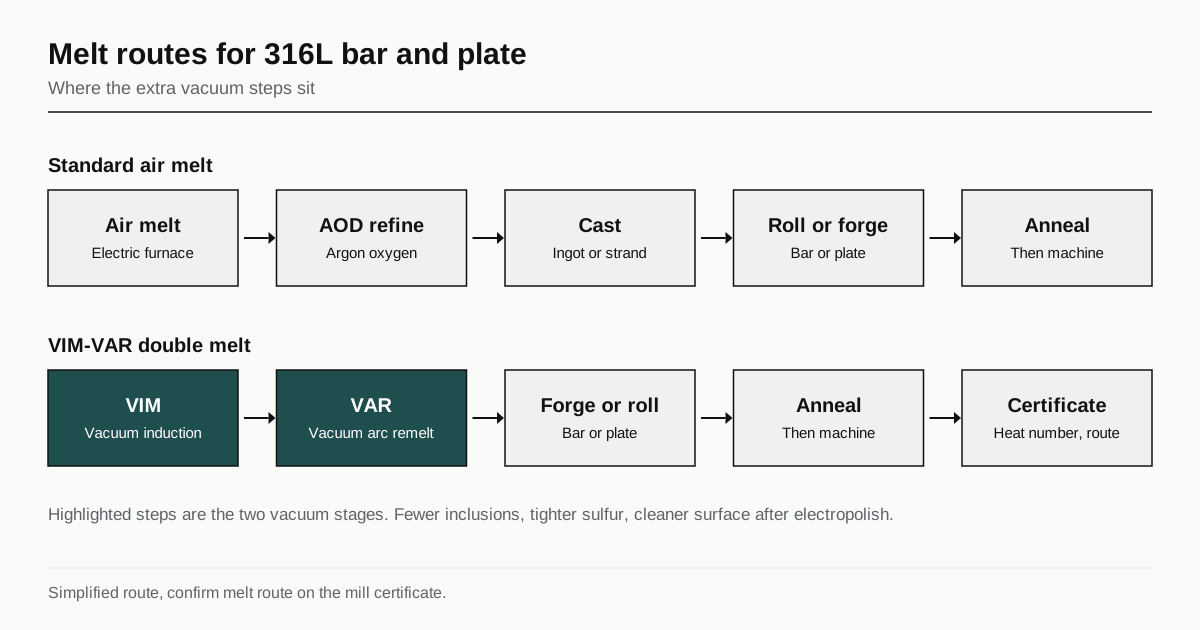
VIM is vacuum induction melting. The metal is melted by induction in a vacuum, which removes dissolved gases and lets the melter control the chemistry closely. The ingot is then remelted by VAR, vacuum arc remelting, in which an electrode of that metal is melted by an arc in a vacuum and solidifies slowly in a water cooled mold.
Two steps in a vacuum give cleaner metal than standard practice. Standard stainless is melted in air, refined in an argon oxygen decarburization vessel and cast. That is a sound process and the dominant one. VIM-VAR adds a second, slower melt that reduces inclusions, trace elements and segregation.
For the buyer, three outcomes matter: fewer and smaller non-metallic inclusions, lower and tighter sulfur, and a more uniform structure from edge to center.
Why sulfur matters for welding
Sulfur is present in all 316L and the standard specification allows up to 0.030 percent. Small differences in sulfur change how a weld pool flows. Higher sulfur gives a wider, shallower weld, and lower sulfur gives a narrower, deeper one. That is why two heats of 316L tube, welded with the same settings on an orbital machine, can make different beads.
For gas line assembly, that variability is a production problem. Orbital welding programs are tuned for a heat, and a change in the heat means a weld that does not match. Low sulfur material has less spread in the penetration, and it is one reason UHP tube is often bought with a tight sulfur range. VIM-VAR melts can reach low sulfur reliably.
| Item | Standard air-melt 316L | Low sulfur 316L | VIM-VAR 316L |
|---|---|---|---|
| Melt route | Air melt, AOD refined | Air melt, AOD, sulfur controlled | Vacuum induction melt, vacuum arc remelt |
| Typical sulfur limit | Up to 0.030 percent | Often a few thousandths of a percent | Often a few thousandths of a percent |
| Inclusion level | Moderate | Moderate to low | Lowest |
| Surface after electropolish | Good | Good | Best |
| Price and lead time | Baseline | Moderate premium | Highest |
Values are typical categories, not promises, and the certificate for the heat is the evidence. For how welding interacts with the process, see TIG and electron beam welding for vacuum parts.
Why inclusions matter for surface
An inclusion is a small particle of oxide or sulfide trapped in the steel. At the surface of a machined and electropolished part, an inclusion can be pulled out or dissolved, leaving a pit. A pit holds moisture and particles and gives the gas a place to contaminate.
Electropolish removes a few micrometers of metal, and it exposes whatever is inside. Cleaner steel exposes fewer defects. That is why high purity applications specify double melt: the finish is judged at the surface, and the surface comes from the material. For finishing, see electropolishing 316L for UHP gas parts.
Inclusion level is rated by metallographic methods such as ASTM E45. A buyer who needs a specific rating has to ask for it on the order, and a test report adds cost and time.
Forms and standards
316L is bought as bar, plate, tube and forgings, each with its own specification. Common references are:
- ASTM A276 and A479 for bar.
- ASTM A240 for plate and sheet.
- ASTM A269 and A270 for tube, the second being a sanitary tube standard.
- ASTM A182 for forged fittings.
These documents set chemistry and mechanical limits for the grade. VIM-VAR is not a grade in them. It is a melt route, and the buyer states it as a supplementary requirement in the purchase order. For a machined part, the shop buys bar or plate with that requirement, and the certificate has to show it.
What to ask for on the certificate
A certificate is the evidence. A useful one shows:
- The specification and grade, for example 316L to a named standard.
- The heat number, which must be marked or traceable to the part.
- The melt route, for example VIM plus VAR.
- The chemical analysis, with sulfur, carbon and the other required elements.
- Mechanical test results.
- The mill name and country of melt, which some buyers restrict.
A shop that cuts parts from bar keeps the heat number on each piece or on a traveler. If the drawing requires traceability, say so, since it adds handling.
When it is worth it
A short test helps.
- Specify VIM-VAR where the buyer’s specification calls it, where the part is a critical wetted gas surface, or where orbital welds across heats have to match.
- Standard 316L may be enough for structure, brackets and parts that are not wetted by process gas. Using double melt on a bracket is waste.
- Low sulfur air melt is a middle option for many gas parts, and the specification should state a sulfur range.
Cost is the tradeoff. The premium is on the raw material, the lead time can run to weeks for non-stocked sizes and minimum quantities can be large. For a small part, the bar cost is a small share of the price. For a large block, it is a large one. The difference is worth knowing before the quote.
What to write on the drawing
- The grade and specification, for example 316L per ASTM A276.
- The melt route: VIM-VAR, or low sulfur with a limit.
- The certificate requirement and heat traceability.
- Any inclusion rating required, with the method.
- The finishing steps, which are separate: electropolish, passivation, cleaning.
- Material origin restrictions, if any.
Lead time, quantity and traceability
Double melt material is not stocked in every size. A mill melts it in lots, and a small order for a specific bar diameter may have to be bought from a distributor who holds it, or wait for a lot. Lead times of several weeks are normal for sizes that are not in stock, and minimum quantities can exceed what a single part needs.
Planning for it is simple. Ask the shop early whether the stock is on hand, and list the acceptable alternatives on the drawing. A drawing that says VIM-VAR only, with no alternative, has no flexibility if the only available bar is a different diameter. Allowing the next larger size costs machining time and saves weeks.
Checking material at receiving
A certificate is a document and does not prove the material in the box. Two checks are common at the shop or at receiving.
- Positive material identification. A handheld XRF analyzer reads the main alloying elements, such as chromium, nickel and molybdenum, in seconds. It cannot measure carbon, so it cannot tell 316 from 316L, and it cannot resolve sulfur at the levels that matter for welding. It confirms the family and not the grade or the melt route.
- Certificate matching. The heat number on the part or the traveler has to match the certificate, and the certificate has to show the melt route that the order asked for.
If the buyer needs a lab analysis of carbon or sulfur, that is an extra test and goes in the RFQ with the number of samples. The finishing steps that follow, described in electropolishing 316L for UHP gas parts, do not change the traceability requirement, and the heat number should survive them.
Next step
State whether VIM-VAR is required by your specification and ask for the certificate. If the melt route is open, say which alternatives you accept. Then send the drawing. It goes to up to three shops that already run this class of part, and a reply comes within 24 business hours. For wider material rules, see the cleanliness and finish guide.
Frequently asked questions
Is VIM-VAR 316L required for all semiconductor gas parts?
No. Many gas components run in standard 316L with a good finish. VIM-VAR is specified where weld consistency, particle risk or surface quality after electropolish justify the premium. The buyer's specification decides.
How can I tell VIM-VAR stock from ordinary 316L?
You cannot by looking at it. The melt route is shown on the mill certificate and the heat number ties the certificate to the material. Ask for the certificate and for the melt route stated on it.
Does double melt remove the need for electropolish?
No. Cleaner steel gives a better surface after electropolish, but the finishing steps are still separate requirements on the drawing.
Have a part like this?
Send the drawing. We match it with up to 3 shops that already run semiconductor equipment parts and reply within 24 business hours.
Send my RFQ