Guides / Process
Electropolishing 316L Stainless for Ultra High Purity Gas Parts: A Buyer's Guide
October 14, 2026
A gas line for a semiconductor tool has to deliver gas that is as clean at the wafer as it was at the cylinder. The inside surface of the tubing, fittings and manifolds matters because rough metal holds moisture and particles. Electropolishing is the standard finish for that surface on 316L stainless steel.
It is a chemical and electrical process, and it is usually done by a specialist. A machine shop’s job is to deliver parts that the process can improve.
What electropolishing does
The part is the anode in a bath, usually a mix of phosphoric and sulfuric acids, and current removes metal from the surface. Peaks dissolve faster than valleys because current concentrates on them, so the surface smooths. The process does four things:
- Smooths the surface, lowering the roughness number.
- Removes a thin layer, and with it embedded particles, burrs and heat tint.
- Leaves a chromium rich oxide layer, which improves corrosion resistance. Iron dissolves preferentially, so the chromium to iron ratio at the surface goes up.
- Rounds sharp edges, which can be good for handling and bad for a sealing edge.
Mechanical polishing smooths by smearing and cutting, and it can leave abrasive embedded in the surface. Electropolishing removes metal without mechanical force, which is why it is preferred for wetted gas surfaces.
How much comes off
Typical removal is a few micrometers to a few tens of micrometers per surface, set by the time and current density. Figures from 5 to 25 um per surface are common in specifications, though the number depends on the part and on what the process has to remove.
That is a dimension change to plan for. Thin wall tubing loses wall thickness, small bores open up and tight fits loosen. The drawing should say whether a dimension is held before or after electropolish, and tight bores should be given a finish dimension that already accounts for the removal.
Finish numbers
Finish is called as Ra, the average roughness. Two values are common for UHP wetted surfaces: Ra 0.38 um (15 microinches) and Ra 0.25 um (10 microinches) or finer. The relevant document for stainless steel wetted surfaces in semiconductor equipment is SEMI F19, and the drawing should name the standard and revision it follows.
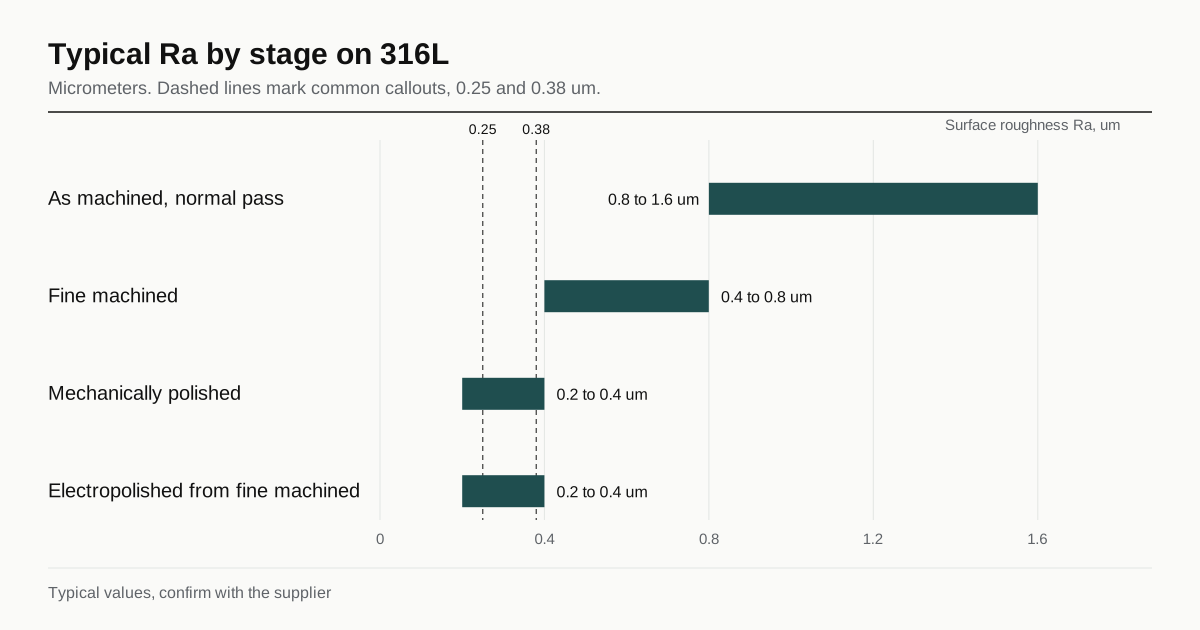
Where the part starts matters as much as the process. Electropolish improves the surface it is given and does not rescue a rough one. Typical Ra values by stage:
| Stage | Typical Ra, um | Comment |
|---|---|---|
| As machined, normal finishing pass | 0.8 to 1.6 | Visible tool marks |
| Fine machined, sharp tool and light pass | 0.4 to 0.8 | Preferred start for electropolish |
| Mechanically polished | 0.2 to 0.4 | Can leave embedded abrasive |
| Electropolished from a fine machined surface | 0.2 to 0.4 | Also removes heat tint |
These are typical figures and the processor’s measurement governs. A callout of Ra 0.25 um after electropolish means the part has to arrive at a finish close to that, and the machining quote has to reflect it.
What electropolishing cannot fix
A short list of problems that come back from the bath unchanged:
- Deep scratches and tears. The surface is smoothed, the scratch is still there.
- Inclusions and porosity. The process can open them up, and they show as pits. The material grade matters, see 316L VIM VAR for UHP gas lines.
- Weld defects. A weld with a lack of fusion or a crevice stays defective and can be exposed.
- Poor geometry. Blind holes and deep narrow slots may not have enough solution flow, so the finish inside is worse than outside.
That last point matters for design. An electropolished surface depends on current reaching it, and a pocket that traps gas or cannot be filled with electrolyte will not polish evenly. Through holes and open geometry polish well. If the part has to be polished inside a blind hole, the drawing should say so and the processor should confirm it can.
Welds and heat tint
Welded gas parts come out with a colored oxide band next to the weld, the heat tint. It is a layer that weakens corrosion resistance and holds contamination. Electropolish removes it, as does pickling and passivation. The weld process matters, so see TIG and electron beam welding for vacuum parts for joint design, and note that the weld has to be sound before it is polished.
A good sequence for a welded gas part is: machine, weld, leak test, electropolish, passivate if the specification asks for it, clean and pack. The leak test goes before the finishing steps because a repair afterward means starting the surface treatment over.
Passivation and cleaning
Passivation is a separate chemical treatment, normally nitric or citric acid, that removes free iron and builds the oxide layer. ASTM A967 covers chemical passivation of stainless steel parts. ASTM B912 covers passivation by electropolishing. Specifications differ on which route is accepted, so the drawing should name one.
After processing, the part is cleaned and packed to the level the drawing gives. Cleanliness notes, double bagging and handling are the same as for other vacuum parts, as in the cleanliness and finish rules.
Masking
Not every face is to be electropolished. Sealing faces may stay as machined, since electropolish can round an edge or soften a flat. Threads are normally masked. The drawing should mark the electropolished surfaces, the masked surfaces and the dimension condition for each.
What to put on the drawing
- Material grade and form, with the mill certificate requirement.
- Finish callout by surface: for example, Ra 0.25 um, internal wetted surfaces only.
- The standard: SEMI F19 or a customer specification.
- Electropolish, then passivation, listed as separate steps if both are required.
- Dimension condition: before or after electropolish.
- Masked areas.
- Cleaning level, packing and the test method for roughness, which is a profilometer on an accessible surface.
Surface area and bath circulation
Electropolish removes metal in proportion to the current that reaches each area, so part shape matters. Sharp external edges and corners draw more current and lose more metal, which is why they round. Recesses, internal corners and long narrow bores draw less and can polish unevenly. Large, simple parts need a cathode placed to reach the surface, and small complex parts may need a purpose-made one. That setup is part of the processor’s price, so a part with deep internal passages should be flagged in the RFQ.
Racking marks and batch effects
A part sits on a fixture in the bath, and the point where the fixture touches it is not polished. That contact mark is a small, unpolished spot, and on a wetted surface it is a defect. The drawing should say where racking contacts are allowed, for example on an outside flange face, and where they are not.
Batch effects are a second source of variation. Bath age, temperature and current density change the amount of metal removed, so two batches of the same part can differ by a few micrometers. For tight tolerances, ask the processor to report the amount removed or to hold a coupon through the batch. For gas parts with a loose tolerance, this is not a worry.
Documentation to request
Gas parts are bought with paperwork. For electropolished parts the useful documents are:
- The processor’s certificate of conformance, naming the process and the standard.
- A roughness reading, with the measuring method and the location.
- The passivation record, if passivation is a separate step.
- The cleaning and packing record.
- The mill certificate for the material, linked to the part by heat number.
These are cheap to produce when requested at the time of order and expensive to reconstruct afterward. Put the list in the RFQ.
Next step
Decide which surfaces are wetted, call the finish only on those and state the standard. Then send the drawing and say who performs the electropolish if you have a preferred processor. It goes to up to three shops that already run this class of part, and a reply comes within 24 business hours.
Frequently asked questions
Does electropolishing replace passivation?
Not by name. Electropolish leaves a chromium rich surface, and some specifications accept it as a passivation route, for example ASTM B912. If the drawing calls passivation separately, it has to be listed as its own step.
Can electropolishing remove tool marks?
It smooths fine marks and removes a thin layer, but a deep scratch or a tear stays visible, only softer. The machined surface has to be close to the target before electropolish starts.
Will electropolishing change my dimensions?
Yes, slightly. A few micrometers per surface come off, so tight bores and thin walls need an allowance. The drawing should say whether the dimension applies before or after electropolish.
Have a part like this?
Send the drawing. We match it with up to 3 shops that already run semiconductor equipment parts and reply within 24 business hours.
Send my RFQ