Guides / Materials
Molybdenum and Titanium Parts in Vacuum Tools: Where Each Metal Earns Its Place
October 19, 2026
Aluminum and 316L stainless cover most vacuum chamber hardware. Molybdenum and titanium show up when those two cannot do the job: a part that sits hot and must not grow, or a part that has to be light, strong and clean at the same time.
This guide covers what each metal is used for, what makes it expensive to machine and which lines belong on the drawing so a shop quotes the real part.
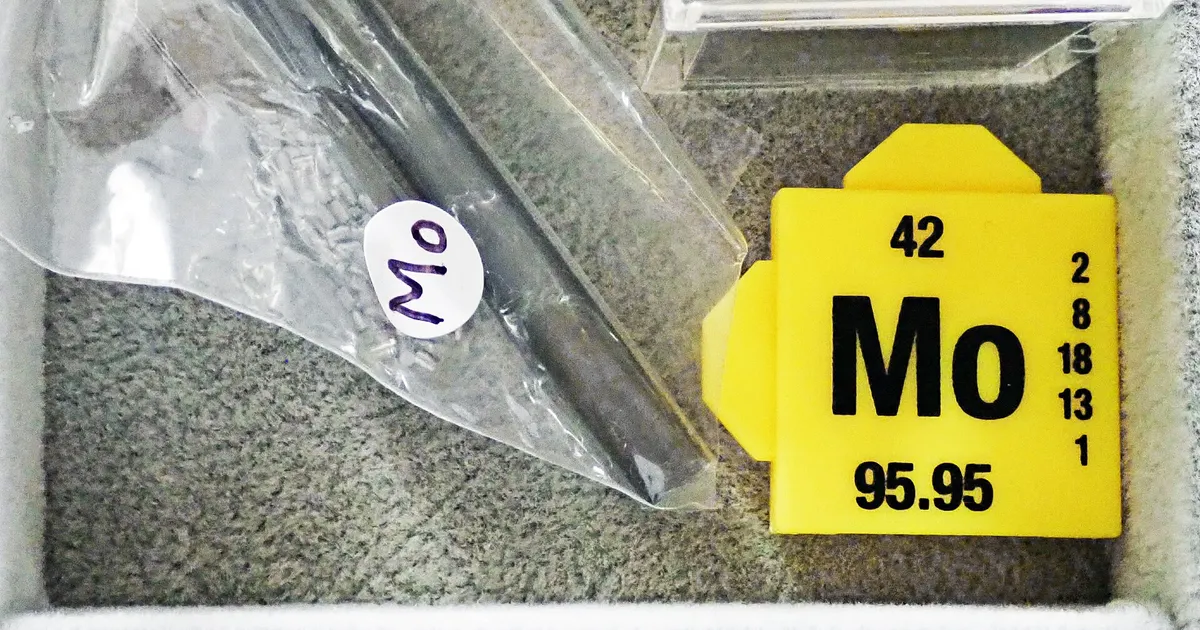
Where molybdenum is used
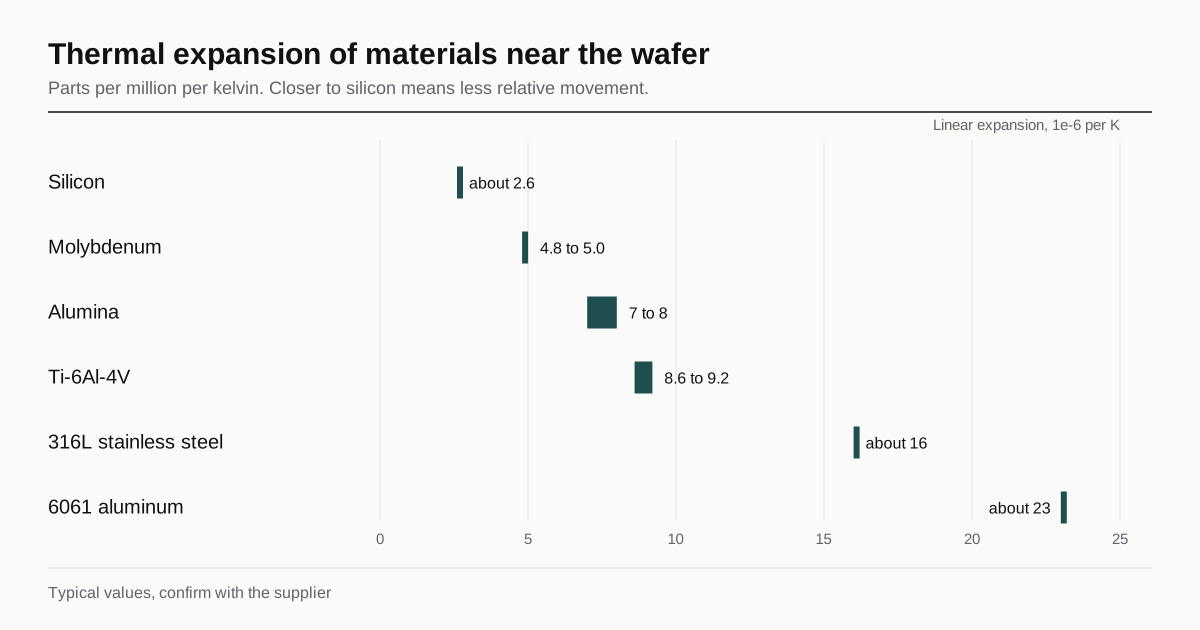
Molybdenum has a melting point near 2,620 degrees C and expands very little when heated. Typical figures put its expansion around 5 parts per million per kelvin, which is close to silicon and between silicon and alumina. Parts that sit next to a wafer or a ceramic heater and run hot are the natural home for it.
Common examples are heater plates and heater support parts, wafer clamps and clamp rings, shields and reflectors inside high temperature chambers, and fixtures for furnaces. It also carries heat well compared with titanium, at about 140 W/m-K as a typical value.
The trade-off is cost and handling. Molybdenum is dense, so a part is heavy, and it oxidizes in air at elevated temperature, so it belongs in vacuum or inert gas at the top of its range. It is brittle below a transition temperature that depends on the product form and the amount of working, so impact and drops matter.
Where titanium is used
Titanium is about 40 percent lighter than steel and strong for its weight. In vacuum tools it appears as fasteners, brackets, support structure, sample and wafer holders, and parts in UHV and cryogenic hardware. Commercially pure grades are softer and weld more easily. Ti-6Al-4V is the common high strength grade.
Two facts matter in vacuum. Titanium reacts with hydrogen and oxygen at elevated temperature, so heat treatment and bake steps are done in vacuum or inert gas. And thermal conductivity is low, in the range of 7 to 22 W/m-K depending on grade, so a titanium part holds heat and heats unevenly. That can be a feature in thermal isolation and a problem in a heater.
Typical properties side by side
The figures below are typical values for common product forms. Confirm them against the datasheet or certificate of the material actually supplied.
| Property | Molybdenum | Ti-6Al-4V | 316L | 6061 aluminum |
|---|---|---|---|---|
| Density, g/cm3 | 10.2 | 4.43 | 8.0 | 2.70 |
| Thermal expansion, ppm/K | 4.8 to 5.0 | 8.6 to 9.2 | 16 | 23 |
| Thermal conductivity, W/m-K | about 138 | about 7 | about 16 | about 167 |
| Melting point, deg C | about 2,620 | about 1,650 | about 1,400 | about 600 |
| Relative machining effort | high | high | medium | low |
Read the expansion row against what the part touches. A molybdenum clamp on a silicon or ceramic part moves very little against it. A 316L part bolted to molybdenum grows three times as much per degree, and the joint has to allow for that. The expansion limits for related materials are in the guide to alumina and aluminum nitride in wafer tools.
Machining molybdenum
Molybdenum is machined with carbide tools at moderate speeds and a good supply of coolant, because the metal is abrasive and chips can be brittle and fragmented. Sharp edges and rigid setups matter. The material can crack or chip at edges if the cut is heavy or the tool is dull, so drawings that allow a small edge break are quoted more easily than a razor edge.
Wire EDM is common for profiles and thin features in molybdenum, since it avoids cutting forces. EDM leaves a recast layer that sometimes has to be removed, and the drawing should say if it must. Grinding is used for flat faces and tight thickness. Welding is difficult, so molybdenum parts are usually made from one piece or joined by brazing or mechanical fastening. Say so in the RFQ if a joint is expected.
Stock form matters. Plate, sheet, rod and sintered blanks are all used, and the grain direction of rolled plate affects flatness after machining. Parts that must stay flat at temperature are often stress relieved between roughing and finishing.
Machining titanium
Titanium is not hard to cut in the way molybdenum is. The trouble is heat: low conductivity means the heat stays at the cutting edge, tool life is short, and a dull tool smears and work hardens the surface. Shops handle it with sharp tools, positive geometry, steady feeds and plenty of coolant.
Two features cost more than they look. Thin walls spring away from the tool, so flatness and thickness are checked after the part rests. Threads in titanium gall against themselves and against stainless steel, which is why the thread callout, the fastener material and the lubricant are drawn together and not left to the assembler. Where lubricant is not allowed in vacuum, the drawing should say what is allowed.
A part that needs deep pockets or an intricate shape in titanium is often machined with a roughing pass, a stress relief and a finishing pass, which adds to the lead time and to the price.
Vacuum and cleanliness notes
Both metals can be used in high vacuum, with conditions.
- Cleaning. Remove cutting fluid and oil before bake. Ultrasonic cleaning in a detergent solution followed by deionized water rinse and drying is typical. The wording belongs in the same style as the cleanliness and surface finish notes used on other chamber parts.
- Bake. A vacuum bake drives off water and hydrogen. Titanium and molybdenum should be baked in vacuum or inert gas, not in air at high temperature.
- Surface. A fine machined surface releases less gas than a rough one, and a bead blasted surface adds area. Use the surface finish the vacuum level needs.
- Marking. Engraving leaves debris and an uneven surface. Mark on a non-critical face or on the bag.
- Magnetic properties. Titanium and molybdenum are non-magnetic in the usual grades, which matters near ion beams and some metrology tools. If the tool needs a specific limit, state it.
What to put on the drawing
A short list covers most of the misunderstandings.
- Material, grade and specification, for example molybdenum by the standard the buyer names, or titanium by grade and the relevant AMS or ASTM standard. Check the current edition before quoting it.
- The condition: annealed, stress relieved or as supplied.
- Flatness and thickness at a stated temperature, with tight values only where the part touches a wafer or a heater.
- Edge break and surface finish, with a note on whether an EDM recast layer is allowed.
- Cleaning, bake and packing steps.
- Certificate: heat or lot number and chemistry.
Cost drivers
Material cost is a larger share of the quote for molybdenum than for any of the common chamber metals, and prices move with the market, so a quote carries a validity date. Titanium is cheaper per kilogram but cuts slowly. For both, the number of setups, the tolerance on flatness and the cleaning requirement move the price more than the shape does. The broader cost picture for chamber parts is in the guide to chamber and wafer handling part costs.
Sourcing and lead time
Both metals come from a smaller supply chain than aluminum or stainless steel. Molybdenum plate and sintered blanks have longer lead times, and cut-to-size stock carries a premium. Titanium plate and bar are easier to find but certified material with full traceability takes time to arrange. Ask the shops in the RFQ to state the stock lead time separately from the machining lead time, because the first often exceeds the second. If the part is a repeat order, say so, since a shop can hold material against a forecast.
Next step
If the choice is between a standard metal and one of these, ask what the part has to survive: a temperature, a mating material or a weight limit. Then send the drawing with the grade and the vacuum notes. It goes to up to three shops that already machine this class of part, and a reply comes within 24 business hours.
Frequently asked questions
Why is molybdenum chosen when it is so hard to machine?
Its expansion is low and close to silicon and ceramics, it holds strength at high temperature and it has a very high melting point. Parts that sit hot and must not move, such as heater plates, clamps and reflectors, are the usual reason.
Is titanium acceptable in a vacuum chamber?
Yes, it is used widely in high vacuum and UHV hardware because it is light, strong and has low magnetic permeability in common grades. The drawing should still name the grade, the cleaning and the surface condition.
Do these metals outgas?
All metals release some gas, mostly water and hydrogen, and the amount depends on the surface condition and the bake. Titanium absorbs hydrogen and molybdenum can hold gas from forming, so cleaning and a vacuum bake are written into the drawing for critical parts.
Have a part like this?
Send the drawing. We match it with up to 3 shops that already run semiconductor equipment parts and reply within 24 business hours.
Send my RFQ