Guides / Materials
Alumina and Aluminum Nitride Ceramics in Wafer Tools: Properties and Machining Limits
October 10, 2026
Wafer tools use ceramics in the places where metal is not good enough: where a part has to be electrically insulating, stay rigid at high temperature, survive plasma or move heat across a wafer. Two ceramics cover most of those places, alumina and aluminum nitride.
They look alike, white to gray, and they are priced and made very differently. A drawing that says only “ceramic” leaves the key decision open.
Where each one is used
Alumina, aluminum oxide, is the general purpose technical ceramic. In wafer tools it appears as end effector blades and pads, insulator rings, chamber liners, spacers and bushings. It is hard, electrically insulating and resists many process gases.
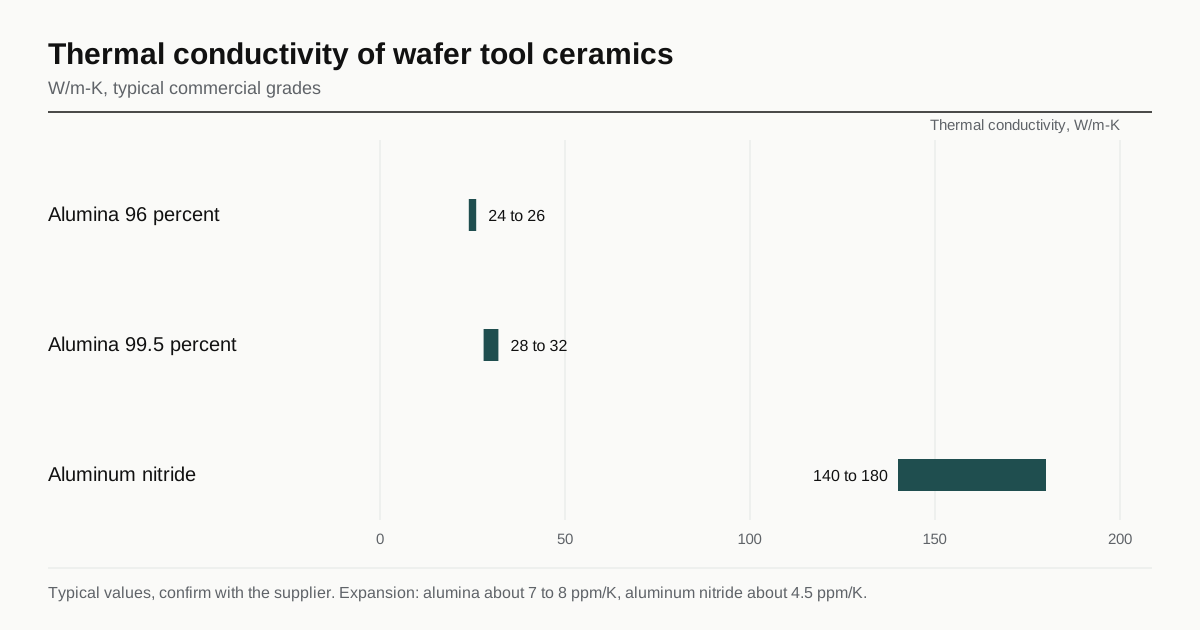
Aluminum nitride, AlN, is chosen for thermal management. Its thermal conductivity is several times that of alumina while it stays electrically insulating, so it is used in heater plates and in the bodies of electrostatic chucks, where heat has to spread evenly across the wafer without a conductive path.
The simple rule: if the part is there for insulation or wear, alumina is the starting point. If heat flow through an insulator is the point, AlN.
Properties side by side
Typical ranges for commercial grades. Values vary with purity, grain size and supplier, and the supplier’s datasheet governs.
| Property | Alumina 96 percent | Alumina 99.5 percent | Aluminum nitride |
|---|---|---|---|
| Density | About 3.7 g/cm3 | About 3.9 g/cm3 | About 3.3 g/cm3 |
| Thermal conductivity | About 24 to 26 W/m-K | About 28 to 32 W/m-K | About 140 to 180 W/m-K |
| Thermal expansion, near room temperature | About 7 to 8 ppm/K | About 7 to 8 ppm/K | About 4.5 ppm/K |
| Flexural strength | About 300 to 350 MPa | About 350 to 400 MPa | About 300 to 350 MPa |
| Electrical behavior | Insulating | Insulating | Insulating |
Two numbers matter most. The thermal conductivity gap is why AlN exists. The lower expansion of AlN sits closer to silicon than alumina does, which reduces thermal mismatch with a wafer or a silicon part bonded to it.
How ceramic parts are made
A ceramic part is not machined like metal. It starts as powder, is pressed or cast into a shape called a green body, and is then fired. Firing shrinks it, by roughly 15 to 20 percent in linear dimension, and the shrinkage is not perfectly uniform.
That sets the process:
- Green machining. The unfired body is soft, like chalk, and can be cut with ordinary tools. Rough shape and some features are made here.
- Sintering. The part is fired and shrinks. As-fired tolerances are typically within about one percent of the dimension.
- Diamond grinding. After firing the part is very hard. Precision faces, holes and threads, where allowed, are ground with diamond wheels. Ground tolerances of a few hundredths of a millimeter are routine and tighter values are possible with cost and time.
- Lapping and polishing. For flatness and finish on wafer contact or sealing faces.
Features that are easy in metal are hard in ceramic. A sharp inside corner concentrates stress and can crack. Thin walls break. Blind holes with a flat bottom are costly. A tapped hole is rarely made in the ceramic itself, and a metal insert or a clamped joint is used instead.
Design rules that save money
A few habits keep a ceramic part makeable:
- Radius inside corners and break outside edges. Sharp edges chip.
- Keep wall thickness uniform, since thick and thin areas shrink differently.
- Avoid long thin features and deep narrow slots.
- Call tight tolerances only on the faces that need them. Ground faces cost far more than as-fired ones.
- Allow a chamfer on holes, because the edge of a ground hole chips easily.
- Design the joint to metal with the expansion difference in mind, since ceramic and metal grow at different rates.
Flatness and size on the metal side of such assemblies are normally proven with a CMM report, see CMM inspection reports for chamber parts.
Handling aluminum nitride
AlN reacts with water slowly and forms aluminum hydroxide, which is why moisture exposure is a concern. For most finished parts, normal handling is fine. During grinding and cleaning, the coolant and the rinse need thought, and the supplier should state the method. A dry or oil based process is common for some work and a water based one for others.
Cleanliness for ceramics follows the rules of the other vacuum materials: no silicone, no fingerprints and a double bag. The cleanliness and finish rules apply to ceramics as well, though ultrasonic cleaning and bake-out steps differ.
Plasma and the coating question
Alumina resists fluorine plasma better than bare aluminum but does not match yttria, and an alumina part near the plasma can slowly erode. AlN in fluorine plasma forms aluminum fluoride on its surface. The process owner decides if the part needs a coating or a different ceramic. For coatings on aluminum chamber parts, see plasma resistant coatings on etch parts.
Who makes the part
Most metal machining shops do not make ceramic parts. A technical ceramic house presses, sinters and grinds them, and some have in-house lapping. If a buyer sends a combined RFQ for a metal assembly and a ceramic part, a shop quoting the whole job is probably subcontracting the ceramic. That is acceptable, and the RFQ should ask who makes it, what the grade is and what the lead time is, since ceramic lead times are often longer than metal.
What to put on the drawing
- The material by grade: alumina with purity, or aluminum nitride with a thermal conductivity requirement if it matters.
- The tolerance class for each face: as-fired or ground.
- Flatness, finish and edge condition on functional faces.
- Radii on inside corners and chamfers on edges.
- Cleaning level and packing.
- The standard for the thermal and electrical properties, with the supplier datasheet attached.
Inspection and defects
Ceramic is brittle, and a defect is usually a crack or a chip. Inspection looks for them with the eye under magnification and, for critical parts, with a fluorescent penetrant. A chip at an edge may be acceptable below a stated size and a crack never is. The drawing should give a limit for edge chips, such as a maximum dimension, and say which faces are inspected.
Flatness and size on ceramic parts are measured on a CMM or an optical system. Ceramics are hard and abrasive, so a contact probe is chosen with care and a very polished face may be checked by interferometer. For how reports should be asked for, see CMM inspection reports for chamber parts.
Joining ceramic to metal
Ceramic parts are rarely used alone. A chuck body is bonded to a metal base, a ring is clamped in a frame and an insulator is held between metal parts. Each joint has to handle the expansion difference. Aluminum grows about three times as much as AlN per degree, and a rigid joint between them stresses the ceramic.
Common solutions are a compliant clamp, a spring or a metal interlayer, brazing with a matched alloy for high temperature parts and a bonded joint with an adhesive that stays soft. These are design choices made by the tool engineer. A machine shop quoting the metal part should know how it will meet the ceramic, because a clamping face with a flatness and finish requirement is a dimension on the metal side of the drawing.
Next step
Name the ceramic grade, mark which faces are ground and which are as-fired, and state the cleaning level. Then send the drawing. It goes to up to three shops that already run this class of part, and a reply comes within 24 business hours.
Frequently asked questions
Can a metal machine shop make alumina or aluminum nitride parts?
Not with its normal tools. Sintered ceramic is ground with diamond tooling and is made by specialist ceramic houses. A metal shop that accepts ceramic work typically subcontracts it, and the RFQ should say who makes the ceramic part.
Why is aluminum nitride more expensive than alumina?
The powder is costlier, the sintering is harder to control and the yield is lower. In return it conducts heat many times better, which is why it appears in heaters and electrostatic chuck bodies.
Does aluminum nitride react with water?
Slowly, and it can form aluminum hydroxide and ammonia in humid or wet conditions. For machined AlN parts, the coolant and cleaning method should be confirmed with the supplier, and the drawing should name the cleaning level.
Have a part like this?
Send the drawing. We match it with up to 3 shops that already run semiconductor equipment parts and reply within 24 business hours.
Send my RFQ